China's Ceramic Tile Export Tax Rebate Cancellation Triggers Industry Shuffle; Quality-Oriented Enterprises Seize New Opportunities
Recently, the Ministry of Finance and the State Taxation Administration jointly issued an announcement, clarifying that starting from April 1, 2026, the value-added tax (VAT) export rebate for ceramic tiles and 16 other construction and sanitary ceramic products will be canceled. This marks the official end of the nearly 40-year tax rebate dividend for China's ceramic export industry. This policy adjustment is not an isolated event but an important measure by the country to promote the transformation and upgrading of the manufacturing industry and optimize the industrial structure, which will have a far-reaching impact on the ceramic export industry.
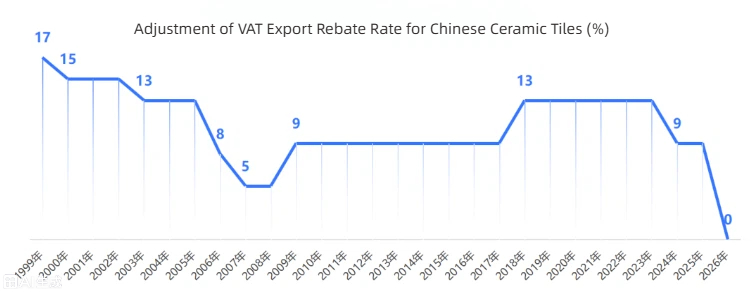
Looking back at the policy history, the export tax rebate rate for construction ceramics has undergone multiple adjustments. It was just reduced from 13% to 9% in December 2024, and this time it directly dropped to zero, forming a gradual adjustment trend of "two reductions in two years". According to industry data, the average export price of China's ceramic tiles fell to 38 yuan per square meter in 2024, and the 9% tax rebate contributed 60% to 75% of the meager profits of export enterprises. For small and medium-sized enterprises that rely on tax rebates to maintain operations, the implementation of the policy will directly trigger a survival crisis. In the short term, the industry will face growing pains such as profit compression and pricing restructuring. Some low-end production capacities with weak bargaining power may be eliminated at an accelerated pace, and even a short-term logistics shortage caused by "rush exports" may occur.
From a long-term perspective, the cancellation of tax rebates is actually a "painful but necessary cure" for the industry. For a long time, some enterprises have fallen into "low-price involution" relying on tax rebate dividends, seizing the market at the cost of sacrificing quality. This policy adjustment will force enterprises to abandon policy dependence, turn to technological innovation, product upgrading and brand building, and promote the industry to shift from "price competition" to "value competition". At the same time, it will also reduce anti-subsidy disputes caused by tax rebates in international trade, clearing obstacles for compliant enterprises to go global.
Against this background, the trend of industry differentiation will become more obvious. Small and medium-sized enterprises that take low prices as their core competitiveness and rely heavily on tax rebates for profits may face the dilemma of soaring costs and order losses; while leading enterprises that focus on quality improvement and have core technologies and brand advantages will seize a larger market share in the industry shuffle by virtue of their strong bargaining power and cost absorption capacity. The market pattern is shifting from "barbaric growth" to "intensive cultivation", and quality and brand have become the key to enterprises' survival.

Faced with industry changes, Beata Ceramics, as an enterprise focusing on ceramic tiles R&D and production, has shown strong anti-risk capabilities. Different from peers relying on tax rebates, Beata Ceramics has firmly taken the path of quality and brand management since its establishment. Its profit model has always centered on product value, and it has never taken tax rebates as the main source of profits, laying a solid foundation for coping with this industry adjustment.
Beata Ceramics has been deeply engaged in the ceramic tiles industry since 1997, which has a strict quality control system and continuous innovation capabilities. Its products have verified by over 1000 projects, covering various categories such as indoor and outdoor tiles, special thick tiles for outdoor use. They have excellent performance such as anti-slip, wear resistance and water resistance, and their specifications and thickness can be flexibly adapted to different scenario needs. The company has always refused "low-price involution", insisting on creating product added value through high-end design and exquisite craftsmanship. Its 3cm-thick porcelain paving tiles have maintained a scarce competitiveness in the market due to high technical thresholds. As a result, it has been recognized by global customers by virtue of quality advantages.
For customers, choosing Beata Ceramics means obtaining more stable quality assurance and a healthier cooperative relationship. Against the background of generally rising industry costs, Beata Ceramics can maximize the absorption of cost pressures brought by the policy by virtue of its mature supply chain management and refined operation capabilities, ensuring the stability of product prices and delivery. In the future, Beata Ceramics will continue to focus on quality upgrading and brand deep cultivation, and achieve win-win development with global customers through more competitive products and services, setting a benchmark for the high-quality development of the ceramic export industry.
Related News
- What Makes Full-Body Facade Porcelain Tiles Ideal For Modern Building Exterior Projects?
- How Can Bespoke Tile Fabrication Support Complex Large‑Scale Outdoor Construction Projects?
- How To Specify Eco Pacing Stone For Humid‑Rainy Coastal African Large‑Scale Real‑Estate Projects?
- Why is Sesame-Grey Eco-Paving Stone Widely Adopted For Diverse Outdoor Paving Projects?
- What Makes Travertine-Look Porcelain Tiles Ideal For Large-Scale Commercial Plaza Projects?
- Mass Production Launched for 600*1200*12mm Full-Body Outdoor Tiles
Leave me a message
News Recommendations