Beyond Durability: Why Outdoor Porcelain Tiles are the Ultimate Solution for Extreme Weather Conditions
We communicate with customers from all over the world every day. Apart from indicators such as thickness, compressive strength and wear resistance that they care about for outdoor flooring materials, customers from countries with extreme climates pay extra attention to parameters closely related to their local weather.
From the brutal freeze-thaw cycles of Northern Europe and Canada to the scorching UV intensity of the Middle East and Australia, every client has distinct concerns. At such moments, we confidently inform customers that our outdoor porcelain tiles are the ideal solution fully capable of withstanding their local climate challenges.
1. Why Porcelain Outdoor tiles Can Defeat The Freeze-Thaw Cycle?
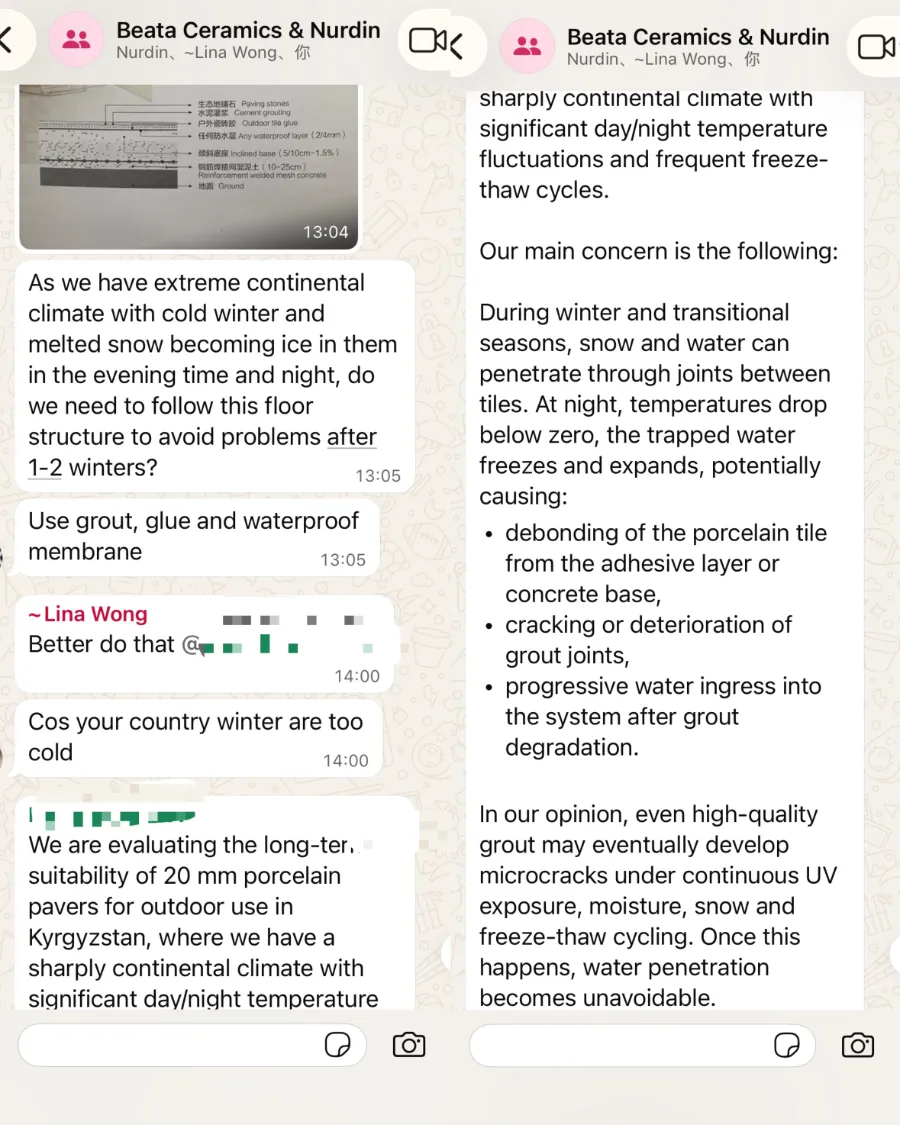
Previously, our client from Kyrgyzstan in Central Asia raised concerns over freeze-thaw cycles, hoping our tiles would remain intact after two full winters. The customer's exact words are shown in the follow picture.
What exactly are freeze-thaw cycles?
The primary culprit of freeze-thaw cycles is moisture. It freezes at -15℃±2℃ and thaws when the temperature rises above 2℃. Repeated expansion of ice will inevitably damage the material itself over cycles. This issue only occurs if construction materials absorb water, such as porous natural stone, water-permeable wooden decks, and low-quality tiles with high water absorption rates. Let’s be honest: outdoor flooring is a massive investment, and Mother Nature doesn't play fair. You spend a fortune on a beautiful timber deck or a natural stone patio, only to watch it crumble, fade, or crack after a couple of brutal winters. It's a frustrating, expensive cycle that most contractors know all too well.
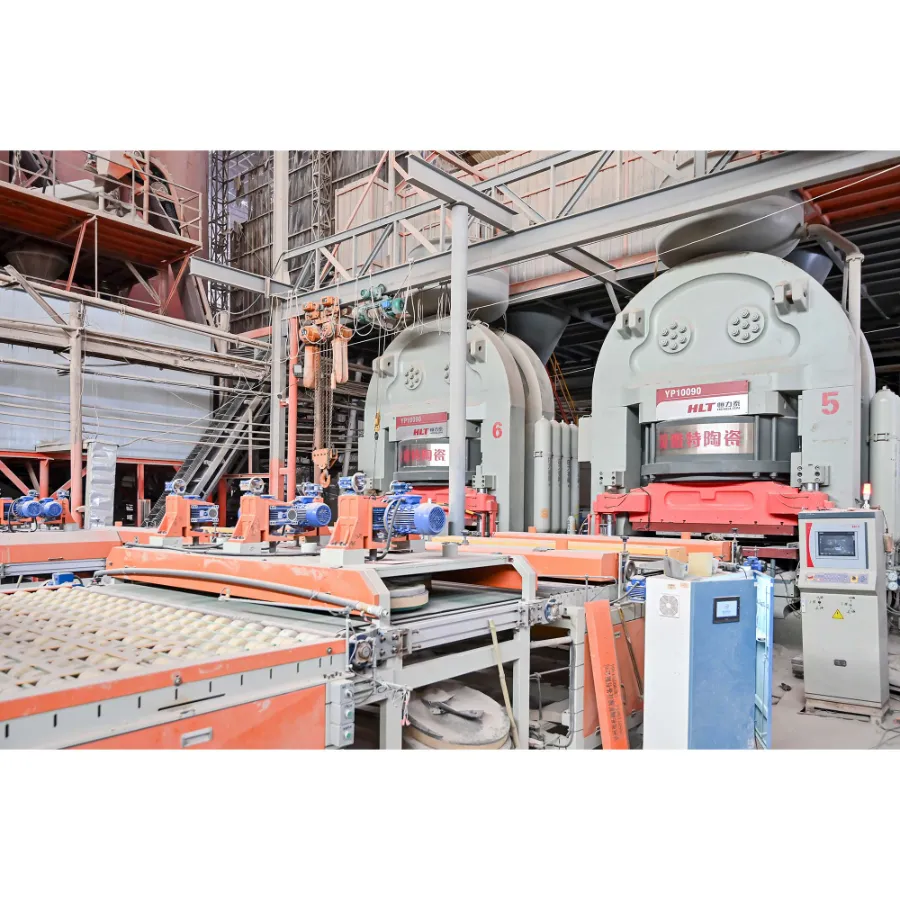
In contrast, Beata Ceramics’ exterior porcelain tiles are pressed by ten-thousand-ton hydraulic presses and fired at 1200℃ to form a compact porcelain body with ultra-low water absorption below 0.5%, barely absorbing any water at all. We have completed hundreds of projects in the northernmost regions of China over a period of at least 10 years without any product failures. We conducted an experiment to verify the frost resistance of our tiles.
As a manufacturer specializing in outdoor tiles, we fully understand the importance of high-end equipment in guaranteeing product quality. Our factory has invested heavily in fully automated production lines, equipped with ten-thousand-ton presses and ultra-long kilns with precise temperature control. Even tiles up to 30mm thick can be fully compacted and thoroughly fired without compromising quality.

2. What Is The Principle Behind The UV Resistance Of Beata Ceramics’ Tiles?
In outdoor environments, material damage from ultraviolet rays mostly comes from the combined effect of UV radiation and rainwater freeze-thaw: after moisture penetrates pores, ultraviolet rays accelerate internal material decomposition and efflorescence whitening.
Beata Ceramics’ outdoor paving tiles feature a protective glaze layer on the surface, which forms a dense glass protective film after high-temperature firing, acting as an inorganic UV barrier to block most direct UV radiation to tile pigments. In addition, thanks to our ultra-low water absorption rate, moisture cannot penetrate the tile body, fundamentally eliminating combined aging caused by UV rays and moisture. The tiles will not turn white or peel after long-term sun exposure. Therefore, our tiles maintain stable color without fading, discoloration or chalking over 20 years of outdoor exposure, suitable for long-term open-air scenarios such as courtyards and curtain walls.
3. Why Do We Recommend Thick Tiles Instead Of Glass Curtain Walls For Countries With Extremely High Temperatures?
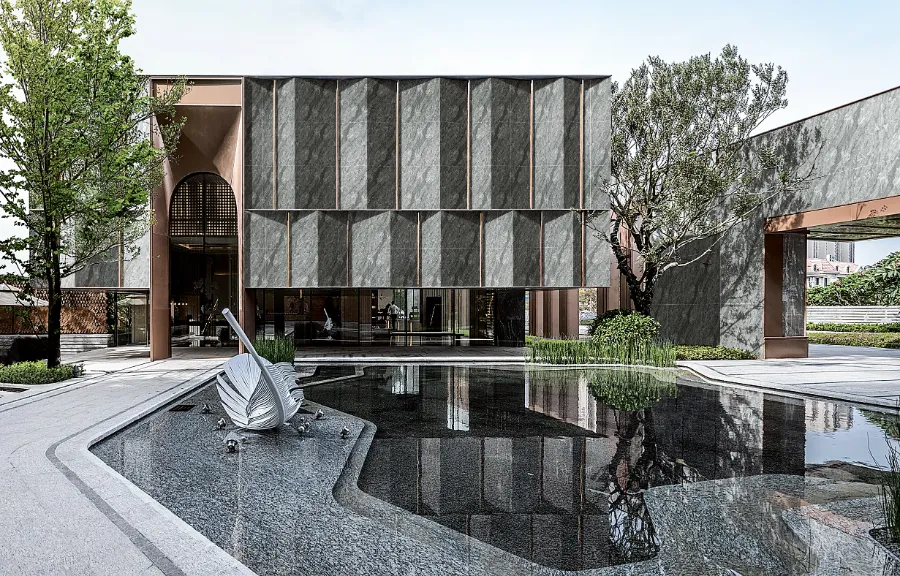
When our thick porcelain tiles (18mm/20mm) are applied to building exterior walls, you will be pleasantly surprised to find that heat waves are effectively blocked outside the wall. The 18mm/20mm thickened tile body extends the heat conduction path. After sunlight hits the tile surface, heat takes far longer to penetrate to the bottom layer, with most heat trapped on the tile surface and drastically less heat transferring inward.
Meanwhile, outdoor tile cladding are usually installed via dry-hung cladding for wall projects, which serves as the core thermal insulation measure. Dry-hung installation creates a 3–6cm stagnant air cavity between tiles and the wall. Air acts as an outstanding thermal insulator, directly blocking heat conduction into the building structure. Furthermore, our tiles’ ultra-low water absorption rate boosts thermal insulation performance. Water conducts heat rapidly, yet our full-body porcelain thick tiles absorb nearly no moisture, maintaining stable low thermal conductivity at all times. Heat penetration will not intensify even after heavy rain followed by intense sunlight.
4.The Aesthetic Revolution: Wood-Look Tiles with Digital Glazing Technology
By now, you may have recognized the merits of outdoor porcelain slabs. Indeed, stone-look tile products have gained global popularity in recent years and won recognition from a growing number of construction practitioners. However, some clients are fond of installing wooden decks or wood-look PVC decks in outdoor spaces, as they adore the rustic grain and texture of timber, and have to put up with the high maintenance required for such materials.
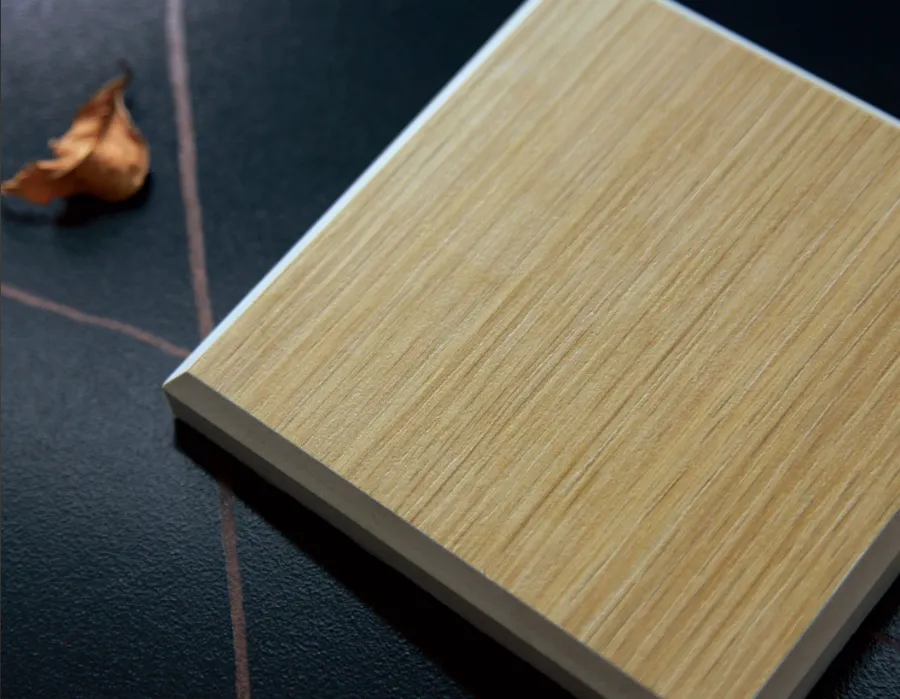
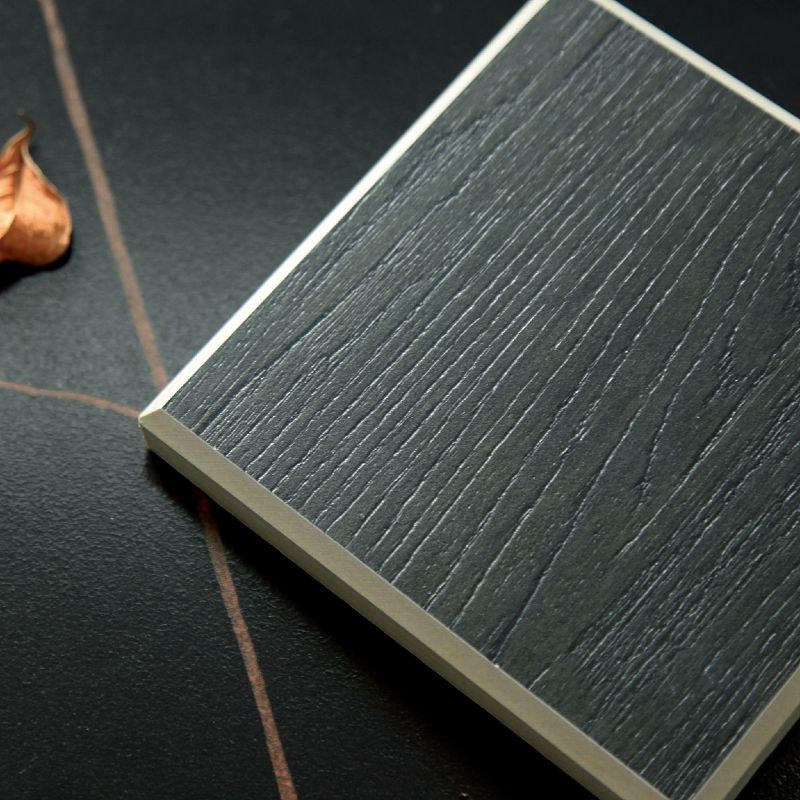
Adopting cutting-edge digital glazing technology, Beata Ceramics produces exquisitely detailed diverse grain patterns that are nearly indistinguishable from real wood. This technology recreates knots, swirling veins and tactile texture of natural oak or teak, while delivering the sturdiness of stone and superior performance exceeding natural stone. These tiles allow designers to create seamless indoor-outdoor transitions, with thinner tiles for living rooms and 1.8cm wood-look paving tiles for terraces. No rot, no splinters and avoid slip hazards when wet, meeting R11 anti-slip standard.
In short, external porcelain tiles have become the most cost-effective outdoor decorative material available today. Visit our website to learn more professional tile knowledge. If you are about to launch a project, feel free to consult us for more suitable solutions!
Related News
- How to Identify High‑Quality Tactile Paving Tiles for Visually‑Impaired Pedestrians?
- What Capabilities Does a Tile Supplier Need for Large-Scale Landscape Paving Projects?
- Beata Ceramics Eco paving Stone Specified for Seoul Station Public Project
- Beata Ceramics Completes 1,500㎡ Outdoor Tile Shipment to Toronto, Expands Canadian Market Layout
- The Art of the Seamless Flow: Why Indoor-Outdoor Coordination is the Future of Luxury Architecture
- Beyond Aesthetics: Why are Porcelain terrazzo tiles a perfect substitute for traditional natural terrazzo?
Leave me a message

News Recommendations